News2 Nov 2026KalshiPolymarket2026 Midterms
Polls and prediction markets point to Democratic gains, but share the same risks
House-control prices approach certainty while the Senate remains tighter and analysts warn that market odds often follow polling rather than independently test it.
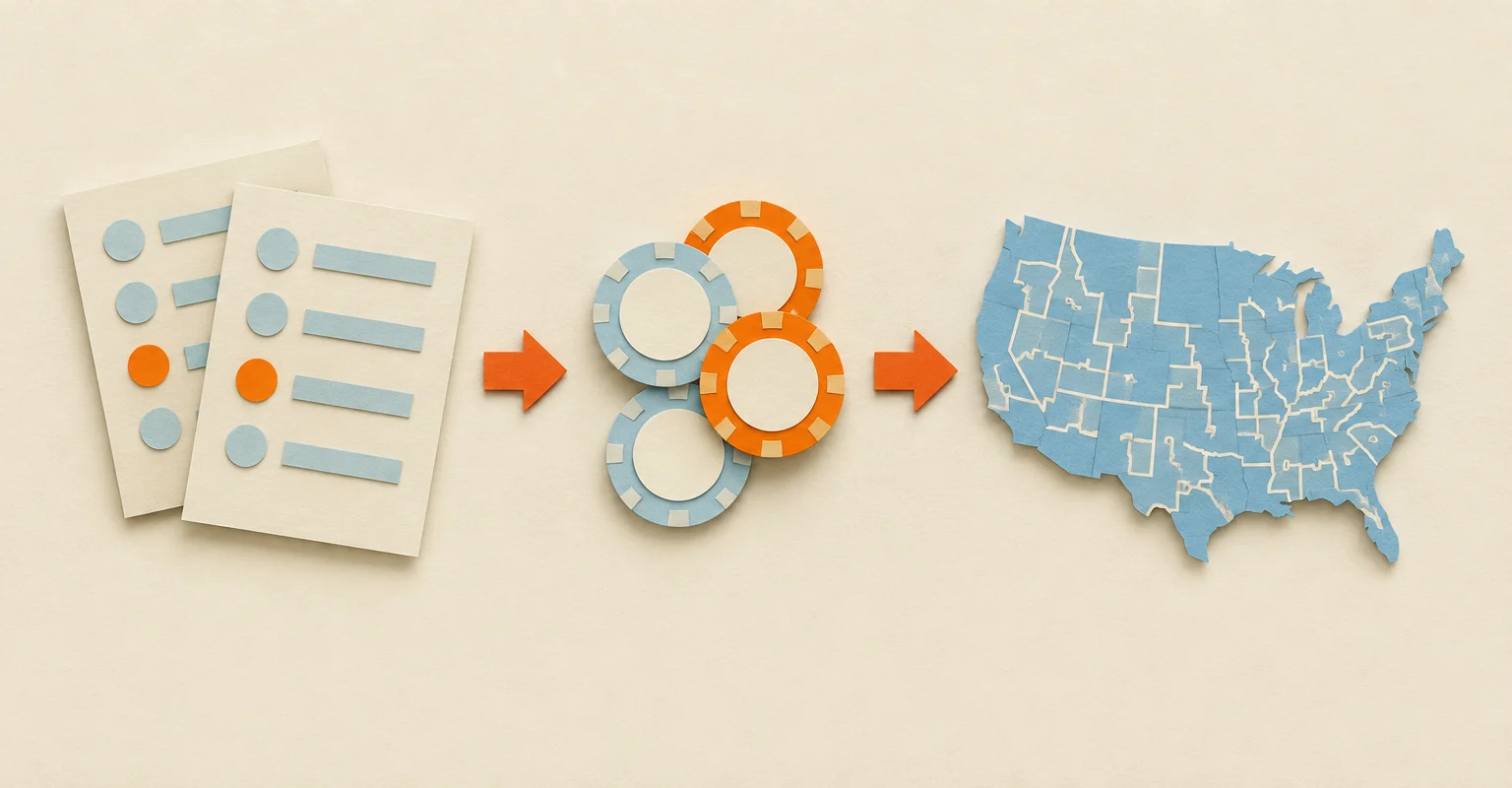
Polling averages and election-betting markets were both showing Democrats with substantial advantages in the contest for control of Congress, although the apparent agreement may be less independent confirmation than it appears.
In a Nov. 1 analysis, Newsweek described the combined signals as a potential Democratic “blue wave.” Its cited RealClearPolling average had Democrats ahead by 8.2 points on the generic congressional ballot, 51.4% to 43.2%, while Nate Silver’s average showed a slightly wider 51.2% to 42.5% Democratic lead.
The latest independently published polling measures pointed in the same direction. RealClearPolitics listed its average at 51.8% Democratic to 43.3% Republican. The October NPR/PBS News/Marist Poll found an 8-point Democratic advantage among likely voters; its survey of 1,289 registered voters was conducted Oct. 19-20 and had a 3.8-point margin of error for likely voters.
Silver Bulletin’s generic-ballot tracker put the Democratic lead at 8.9 points after it had reached a cycle high of 9.2 points. Its likely-voter adjustment increased the margin to 9.1 points. The tracker combines surveys of adults, registered voters and likely voters, and weights them for such factors as pollster rating, sample size, recency and house effects.
The prediction-market prices were even more emphatic about the House. Kalshi traders gave Democrats a 69% chance of taking the Senate and a 92% chance of winning a House majority. Polymarket put the probabilities at 72% for the Senate and 94% for the House.
Silver Bulletin’s election model likewise put Democrats’ chance of retaking the House at about 95% and projected an average net gain of 25 seats. It described the Senate contest as more competitive, though with a meaningful Democratic advantage. Democrats need a net gain of four Republican-held seats to control that chamber.
Texas illustrated both the opportunity and the uncertainty. James Talarico led Republican Ken Paxton in polling, according to Newsweek, and was the clear market favorite. NPR found that Talarico had led almost every Texas Senate poll, though those leads were within the margin of error. A Democratic win would make Texas Democratic in a Senate election for the first time since 1988.
The Senate map remains materially tighter than the House outlook. The Cook Political Report classified Alaska, Iowa, Kansas, Ohio and Texas as toss-ups, while North Carolina and Georgia had shifted to likely Democratic, NPR reported. It said Republican turnout could determine whether Democrats gain one or two Senate seats or six or seven.
There are reasons to be cautious about treating the poll and market readings as separate validations. Newsweek noted that prediction markets largely read polling results, so the two could succeed or fail together. Christopher Wlezien said that excessive clustering in polling makes him nervous.
Historical evidence offered a mixed assessment of polling. Andrew Gelman said public polls overstated Democrats by two or three points on average in the 2016, 2020 and 2024 presidential elections, but were close in the 2018 and 2022 midterms. Robert Erikson said state polls had generally been accurate except when Donald Trump was on the ballot, when Republican Senate candidates outperformed them; he said that bias disappeared in 2018 and 2022.
Polling practices have changed in response to participation gaps. Pew Research Center found that nearly 70% of national election polls in 2024 weighted samples by party affiliation or prior vote, and said the approach had modestly improved accuracy. It also said Republicans had become slightly less likely than Democrats to take part in polls, making such weighting more necessary.
The markets themselves have a patchy record. Kalshi and Polymarket attracted attention in 2024 when they favored Trump on election morning while polls showed a toss-up. But both platforms gave Flávio Bolsonaro roughly an 80% chance of winning Brazil’s Oct. 25 runoff before Luiz Inácio Lula da Silva won by nearly 4.4 million votes.
Research by Erikson and Wlezien found that election-eve betting prices added nothing to polls’ predictive power after scientific polling emerged, and that departures from polls “added error rather than further accuracy.” Their earlier work found adjusted poll forecasts beat winner-take-all Iowa Electronic Markets prices 87% of the time.
More than $1.4 billion had been traded on 2026 midterm contracts, Newsweek said, increasing scrutiny of insider trading and market integrity. Federal regulators had vowed a crackdown, Kalshi had suspended six candidates for betting on their own races, and Polymarket said it had investigated dozens of election bets, with at least two reportedly referred to the Commodity Futures Trading Commission. The Senate also barred its members and staff from trading on prediction markets.
Sources
Earlier coverage
- Polymarket gives Democrats 92% chance of taking House
- Midterm election betting tops 2024 total as contracts proliferate
- Bloomberg election page tracks $230 million in Kalshi control contracts
- News outlets add prediction-market partners before the midterms
- WBUR examines election prediction markets’ rise and insider-risk concerns
Researched and written by Cite, an automated research pipeline. Sources are linked above.