News12 Oct 2026KalshiPolymarketNFLSports BettingCFTCSupreme Court
Football drives Kalshi and Polymarket to record $22.2 billion week
NFL and college games produced $8.56 billion in two days as sports contracts deepen the industry’s regulatory fight.
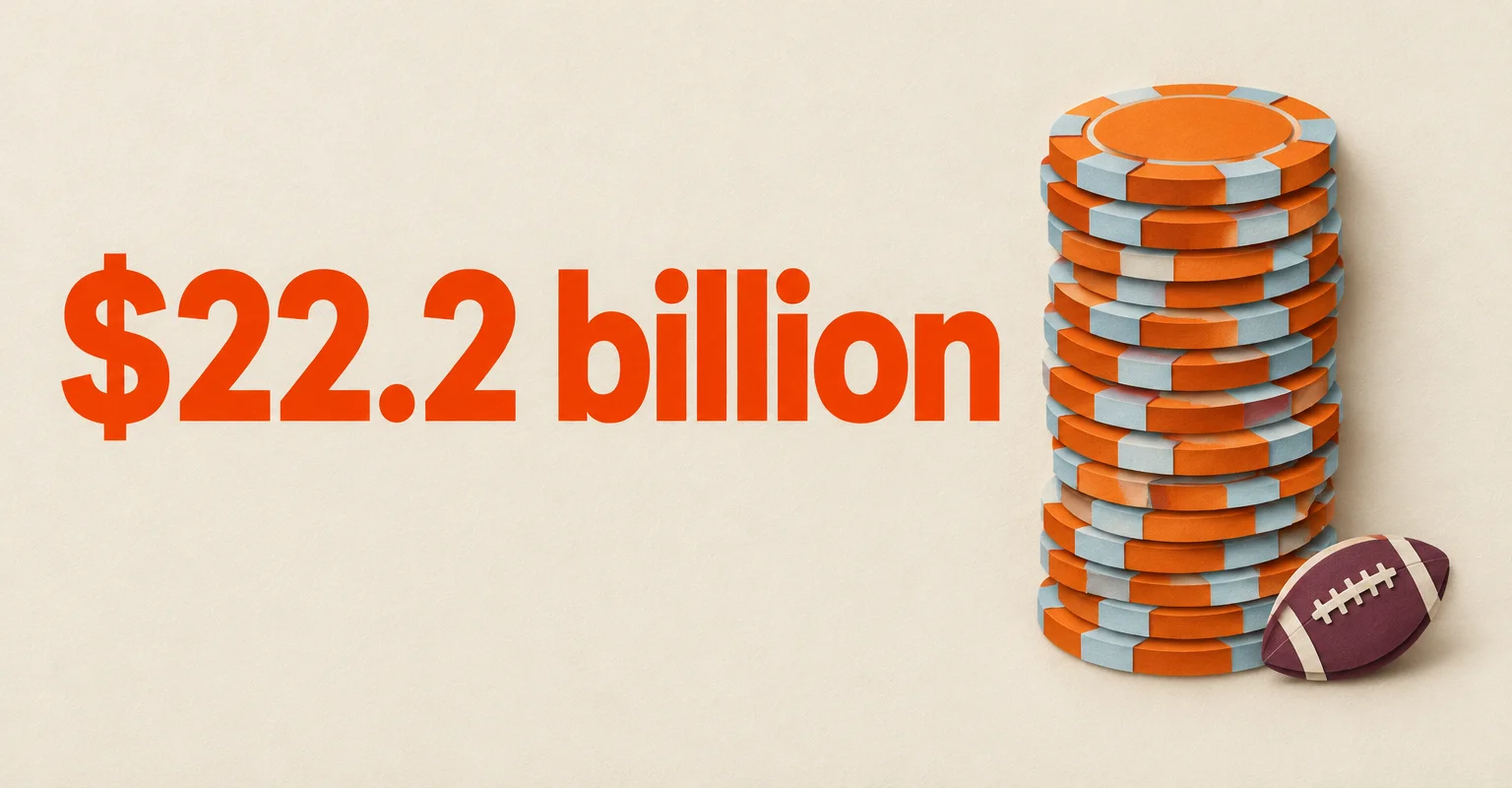
NFL and college-football games pushed Kalshi and Polymarket to two consecutive daily trading records over the weekend, generating a combined $8.56 billion in trading. Their weekly volume reached a record $22.2 billion.
The surge adds to a football-season acceleration already evident in September, when our earlier coverage found NFL prediction trading had exceeded $1 billion in the season’s opening full week. More than 80% of Kalshi’s September volume came from sports during the NFL season’s first four weeks.
Combo contracts represented 65% of Kalshi’s volume and 53% of Polymarket US volume in the reported week, with most tied to sports. At least 96% of Kalshi combos were sports-related, according to Elisabeth Diana, the company’s communications lead.
Kalshi’s combo volume averaged about $1.36 billion on days with substantial NFL and college-football activity, more than twice the level on days without major football games. That single-day average exceeded the roughly $900 million in combo volume Kalshi recorded during the entire previous NFL regular season.
The growth extends a trend documented by Pew Research Center before the NFL season began. Combined monthly global volume at Kalshi and Polymarket doubled from $26 billion in May to $53 billion in July, largely because of sports, before easing to $47 billion in August. Sports became the largest trading subject on both platforms by a wide margin.
The expanding sports business has intensified a dispute over whether event contracts are federally regulated financial products or gambling subject to state law. Prediction markets’ federal exchange classification allows them to avoid state gambling taxes, including New York’s 51% levy, as well as the age and location restrictions imposed on sportsbooks. Kalshi says its exchange matches buyers and sellers rather than taking the other side of their trades, and therefore is not gambling.
At least 44 states, including New York, Arizona and Connecticut, contend that sports-event contracts are illegal gambling under state law. Federal appeals courts have reached conflicting conclusions: the 3rd U.S. Circuit Court of Appeals blocked New Jersey from enforcing its gambling laws against Kalshi, while the 9th Circuit ruled that sports contracts fall under Nevada law.
The NFL has backed New Jersey’s request for Supreme Court review, filing an amicus brief alongside attorneys general from 39 states and the District of Columbia. The league argues that the Commodity Futures Trading Commission lacks sufficient capacity to protect game integrity, citing the agency’s 543 employees, and has objected to markets involving officiating, individual player performance and events that can be known in advance.
Traditional sportsbook operators are also adapting. DraftKings and FanDuel are developing prediction-market products aimed at customers in states where their sportsbooks cannot operate, though both remain behind Kalshi and Polymarket in trading volume and customer adoption. Kalshi, meanwhile, is considering an initial public offering after a funding round valued it at about $40 billion.
Sources
Earlier coverage
- Polymarket US gains ground as weekly prediction trading reaches $19.46 billion
- NFL prediction trading tops $1.035 billion as Kalshi dominates
- NFL, tennis and the Fed lift prediction markets to $14.1 billion
- Prediction markets reached $188 billion in third-quarter trading
- NBC says NFL season could be prediction markets’ biggest yet
Researched and written by Cite, an automated research pipeline. Sources are linked above.